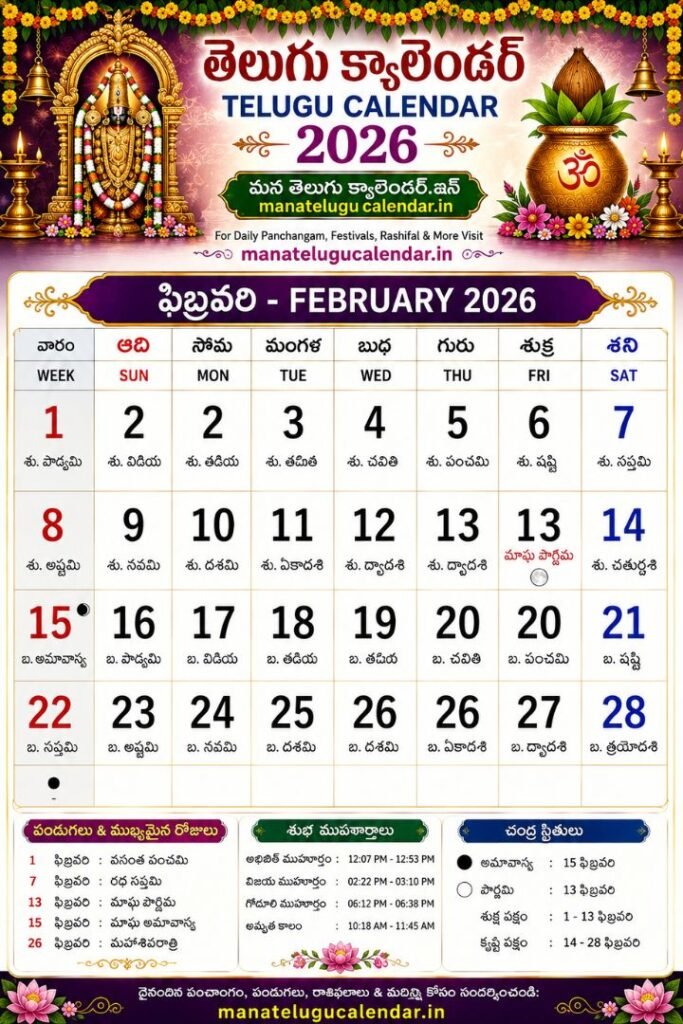
February 2026 is a month of transition on the Telugu calendar. It opens with Magha Masam still in progress and closes with Phalguna Masam — the last month of the Telugu lunar year, Viswavasu Nama Samvatsaram — already underway. In between, the month carries some of the year’s most significant observances: Magha Pournami, Maha Shivaratri, Phalguna Amavasya, and two Ekadashi fasting days.
This guide lays out the Telugu Calendar for February 2026 in plain, easy-to-follow language, based on standard Andhra Pradesh and Telangana Panchangam conventions (Hyderabad reference point). Because exact Tithi and Nakshatra timings shift by a few hours depending on your city, always confirm precise muhurtham windows with your family priest or a local Panchangam before finalising an important date.
How to Download and Use This Telugu Calendar for February 2026
If you’d like a copy of this calendar to keep handy through the month — on your phone, printed out, or pinned near the family altar — you can save this page directly from your browser using the “Save as PDF” or “Print” option, which keeps the festival table above intact for quick reference. If your family follows a specific temple or regional Panchangam (Vishakhapatnam, Tirupati, or a family-specific version), it’s worth cross-checking that source too, since a few Nakshatra and Tithi timings can vary by an hour or two depending on the calculation method used.
Amanta vs. Purnimanta: Why Your Telugu Calendar May Look Different from a North Indian One
If you’ve compared a Telugu Panchangam with a Hindi calendar for the same month, you may have noticed the month names don’t always match. That’s because most of North India follows the Purnimanta system, where a lunar month begins right after Purnima (full moon), while Andhra Pradesh, Telangana, Karnataka, and Maharashtra follow the Amanta system, where the month begins after Amavasya (new moon).
This is why, in the Purnimanta reckoning, Phalguna Masam is already said to have started on February 2, 2026, while in the Telugu Amanta calendar, Phalguna Masam only begins on February 18, 2026 — a difference of over two weeks in month-naming, even though both calendars agree on the actual festival dates like Maha Shivaratri and Ekadashi, since those are tied to the Tithi (lunar day), not the month name.
Understanding the Five Limbs of the Panchangam
If you’re new to reading a Telugu calendar, it helps to know that “Panchangam” literally means “five limbs,” referring to the five elements calculated for every single day:
- Tithi — the lunar day, based on the angular distance between the sun and moon (this is what determines Ekadashi, Amavasya, Pournami, and Chaturthi)
- Vara — the weekday (Sunday through Saturday)
- Nakshatra — the star constellation the moon is passing through, important for naming ceremonies and muhurtham selection
- Yoga — a calculated combination of the sun and moon’s positions, used mainly by astrologers
- Karana — half of a Tithi, used for finer muhurtham calculations
When you see a festival listed for “February 15,” what’s actually being tracked behind the scenes is a specific Tithi (Chaturdashi, in Shivaratri’s case) intersecting with a specific sunrise or sunset on the Gregorian calendar. This is also exactly why festival dates shift every year rather than falling on a fixed Gregorian date — the Tithi cycle (about 29.5 days) doesn’t line up neatly with the 30- or 31-day Gregorian month.
Telugu Calendar Festivals and Panchangam Dates: February 2026
Below is a simplified table of the key festivals, vrats, and Panchangam highlights for February 2026, cross-checked against multiple Panchangam sources for accuracy.
| Date (2026) | Day | Tithi | Festival / Vratam |
|---|---|---|---|
| February 1 | Sunday | Magha Shuddha Pournami | Magha Pournami (Full Moon) |
| February 5 | Thursday | Krishna Chaturthi | Dwijapriya Sankashtahara Chaturthi (Ganesha Vratam) |
| February 13 | Friday | Krishna Ekadashi | Vijaya Ekadashi |
| February 14 | Saturday | Krishna Trayodashi | Shani Pradosha Vratam |
| February 15 | Sunday | Krishna Chaturdashi | Maha Shivaratri |
| February 17 | Tuesday | Amavasya | Phalguna Amavasya (New Moon) |
| February 18 | Wednesday | Shukla Pratipada | Phalguna Masam begins; Chandra Darshanam |
| February 19 | Thursday | — | Ramadan begins in India (first Roza) |
| February 27 | Friday | Shukla Ekadashi | Amalaki Ekadashi |
| February 28 | Saturday | Shukla Trayodashi | Shani Pradosha Vratam |
A quick accuracy note: the Shukla Paksha Pradosha Vratam at the end of the month falls right at the Tithi boundary between February 28 and March 1, so some regional Panchangams list it on February 28 and others on March 1 — both are correct depending on which Tithi is prevailing at sunset in your city. Always check your local temple’s Panchangam for the exact day.
Major Telugu Festivals in February 2026
Magha Pournami — February 1, 2026
Magha Pournami is the full moon day of Magha Masam and marks the end of the month’s most sacred bathing and charity period, Magha Snanam. Many devotees take a holy dip in a river or tank at dawn and perform Satyanarayana Puja on this day. Since it falls on a Sunday in 2026, temples across Andhra Pradesh and Telangana typically see larger-than-usual crowds.
Dwijapriya Sankashtahara Chaturthi — February 5, 2026
This is the monthly Ganesha vratam observed on the fourth day of the waning moon. Devotees fast through the day and break the fast only after sighting the moon in the evening, typically around 9:40 PM in most Telugu-speaking regions. It’s considered a day for removing obstacles and starting fresh with clarity.
Vijaya Ekadashi — February 13, 2026
Vijaya Ekadashi falls on the eleventh day of Magha’s waning fortnight and is dedicated to Lord Vishnu. It’s regarded as one of the more powerful Ekadashis of the year, associated with victory over obstacles — the name itself means “victorious.” Many households observe a full-day fast, breaking it only the next morning.
Maha Shivaratri — February 15, 2026
The Great Night of Shiva falls on the Chaturdashi tithi just before Phalguna Amavasya. Devotees across Telugu households observe a day-long fast and keep vigil through the night with four watches of worship (Prahar Puja), visiting Shiva temples like those at Srisailam and Kaleshwaram in particularly large numbers. Since Maha Shivaratri and Masika Shivaratri (the monthly Shivaratri) coincide on the same date this year, February 15 carries a double significance for Shiva devotees.
Phalguna Amavasya — February 17, 2026
This new moon day is traditionally reserved for Pitru Tarpanam — offerings to ancestors — along with charitable acts and quiet reflection. It also marks the final day of Magha Masam before Phalguna Masam begins. As with all Amavasya days, it’s generally considered a day to avoid launching new ventures and instead focus on ancestral remembrance.
Amalaki Ekadashi — February 27, 2026
Falling in the waxing fortnight of Phalguna Masam, Amalaki Ekadashi is dedicated to worship of both Lord Vishnu and the Amla (gooseberry) tree, believed to be sacred to him. Devotees often perform puja at the base of an Amla tree in addition to the usual Ekadashi fast.
Ramadan Begins — February 19, 2026 (India)
Alongside the Telugu Panchangam observances, February 2026 also marks the start of Ramadan for the Muslim community. While the Gulf countries began Ramadan on February 18 following their moon sighting, India’s moon-sighting committees confirmed the crescent a day later, placing the first Roza on Thursday, February 19, 2026.
Auspicious Muhurtham Days in Phalguna Masam 2026
Once Phalguna Masam begins on February 18, many Telugu families start checking the Panchangam for muhurtham dates suited to weddings, Griha Pravesham (housewarming), Namakaranam (naming ceremony), and Aksharabhyasam. That said, the solar month or lunar Masam name alone doesn’t decide auspiciousness — it depends on the specific Tithi, Nakshatra, and the individuals’ horoscopes involved. A few points worth keeping in mind:
- Avoid Amavasya (February 17) and Rahu Kalam windows for launching new ventures or ceremonies
- Cross-check any prospective wedding or Griha Pravesham date against both partners’ Nakshatra and birth charts
- Treat Ekadashi and Pradosha days as fasting and worship days rather than celebration days
- Consult a qualified astrologer or purohit before finalising any major family event, since printed calendars only give generic guidance
Why the Telugu Calendar Still Matters Today
Even with digital reminders on every phone, the Telugu Panchangam remains central to how Telugu households in Andhra Pradesh, Telangana, and across the diaspora in the US, UK, Canada, Singapore, and the Gulf plan their year. It’s not only about tracking festival dates — it connects families to agricultural cycles, temple traditions, and rituals passed down for generations. Knowing exactly when Magha ends and Phalguna begins, or when the next Ekadashi or Amavasya falls, helps in planning everything from a simple Satyanarayana Vratam to a full wedding season around dates that carry real cultural weight.
Frequently Asked Questions
When does Phalguna Masam start in the Telugu calendar in 2026? Phalguna Masam begins on Wednesday, February 18, 2026, right after Phalguna Amavasya, and continues until around March 19.
Is there a full moon (Pournami) in February 2026? Yes, Magha Pournami falls on February 1, 2026.
When is Maha Shivaratri in the Telugu calendar in 2026? Maha Shivaratri falls on Sunday, February 15, 2026, and coincides with the monthly Masika Shivaratri this year.
How many Ekadashi days fall in February 2026? Two: Vijaya Ekadashi on February 13 and Amalaki Ekadashi on February 27.
Why does the Telugu calendar show a different month than the Hindi Panchang for the same dates? The Telugu calendar follows the Amanta (new-moon-ending) system, while most North Indian calendars follow the Purnimanta (full-moon-ending) system, so month names can shift by up to two weeks even though festival Tithis line up.