January is the month every Telugu household waits for. It carries Makara Sankranti — the biggest harvest festival on the Telugu calendar — along with Bhogi, Kanuma, a handful of Ekadashi and Pradosha fasting days, and the year’s first Amavasya and Purnima observances. This page lays out the complete Telugu Calendar 2026 January in plain, easy-to-follow order, based on the traditional Telugu Panchangam.
Every date below follows the standard lunisolar Panchang used across Andhra Pradesh and Telangana. Tithi transitions can shift slightly depending on your city’s sunrise time, so treat the boundaries as close approximations and check a local Panchangam for anything time-sensitive, like a puja muhurtam.
Download the Telugu Calendar 2026 January PDF
If you’d rather have this on hand without scrolling through a webpage, a downloadable PDF version of the January 2026 Telugu calendar is available below, along with a high-resolution image you can save straight to your phone. Both cover the same festival, vratam, and Panchangam details listed on this page.
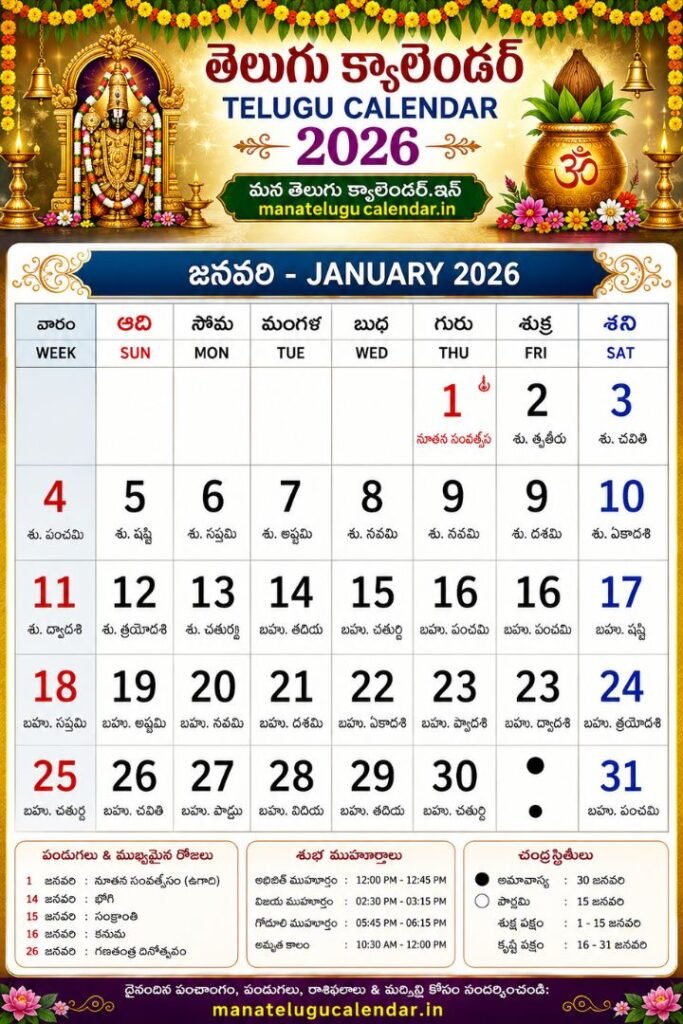
Makara Sankranti 2026 at a Glance
| Detail | Information |
|---|---|
| Festival | Makara Sankranti |
| Date | Wednesday, January 14, 2026 |
| Preceded by | Bhogi (January 13) |
| Followed by | Kanuma (January 15) |
| Significance | Sun’s transition into Makara Rasi (Capricorn); harvest thanksgiving |
| Observed in | Andhra Pradesh, Telangana, and Telugu communities worldwide |
Telugu Calendar Festivals & Vratams — January 2026
| Date | Day | Festival / Vratam |
|---|---|---|
| Jan 1 | Thursday | English New Year; Guru Pradosha Vratham |
| Jan 3 | Saturday | Pushya Pournami (Full Moon) |
| Jan 8 | Thursday | Sankatahara Chaturthi |
| Jan 10 | Saturday | Skanda Shashthi |
| Jan 13 | Tuesday | Bhogi |
| Jan 14 | Wednesday | Makara Sankranti |
| Jan 15 | Thursday | Kanuma |
| Jan 16 | Friday | Satyanarayana Vratham; Shukra Pradosha Vratham |
| Jan 17 | Saturday | Masa Shivaratri |
| Jan 18 | Sunday | Mauni Amavasya |
| Jan 19 | Monday | Chandra Darshan |
| Jan 23 | Friday | Vasant Panchami |
| Jan 25 | Sunday | Ratha Saptami |
| Jan 26 | Monday | Republic Day |
| Jan 29 | Thursday | Jaya Ekadashi (Fasting) |
| Jan 30 | Friday | Shukra Pradosha Vratham |
Understanding Sankranti: Andhra & Telangana’s Biggest Festival
Sankranti in Telugu households isn’t confined to a single day — it plays out over three, sometimes celebrated as a fourth day called Mukkanuma in some communities.
Bhogi (January 13) opens the festival with a pre-dawn bonfire, known as Bhogi Mantalu, where old wooden items and dried leaves are burned together as a symbolic clearing-out before the new harvest season. Later that morning, children are showered with regi pallu (jujube fruit) mixed with flowers and coins in a ritual called Bhogi Pallu, believed to protect them from the evil eye.
Makara Sankranti (January 14) is the main event, marking the sun’s entry into Makara Rasi and the start of Uttarayana, the sun’s northward movement. Homes are decorated with elaborate muggu (rangoli) patterns, often centred around Gobbemma, small dung figures worshipped as a form of Goddess Gauri. Families cook a mix of rice, jaggery, and lentils as a harvest offering, and it’s traditionally treated as the most auspicious of the three days.
Kanuma (January 15) is dedicated to cattle. Farming families wash, decorate, and honour their bulls and cows for the role they played in bringing in the harvest, and it’s also considered a good day for buying vehicles or starting new farm-related work, given the day’s association with prosperity through livestock.
What Is the Telugu Panchangam?
The word Panchangam translates to “five limbs,” and it’s the daily almanac that Telugu astrologers and priests use to work out auspicious timing for everything from weddings to shop openings. The five elements it tracks are:
- Tithi — the lunar day, of which there are 30 in a full lunar month, split evenly between the waxing (Shukla Paksha) and waning (Krishna Paksha) fortnights.
- Vara — the weekday, each associated with a presiding deity (which is why you’ll see names like Guru Pradosham on a Thursday or Shukra Pradosham on a Friday).
- Nakshatra — the star constellation the moon occupies on a given day, important for matching horoscopes and timing ceremonies.
- Yoga — a calculated combination of the sun and moon’s positions, used to judge whether a day carries a favourable or unfavourable disposition.
- Karana — half of a tithi, used for finer-grained muhurtam calculations.
Priests combine all five to arrive at a Muhurtam — the precise auspicious window for weddings, Griha Pravesam (housewarming), Namakaranam (naming ceremonies), and other significant life events. This is also why two Panchangams calculated for different cities can show a festival or vratam date shifting by a day: the underlying tithi doesn’t always begin and end at midnight, so which calendar day it gets assigned to depends on the local sunrise.
Amavasya, Purnima & the Panchangam Behind This Calendar
Two lunar milestones anchor January 2026’s Panchangam. Pushya Purnima falls on January 3, the full moon marking the peak of the Pushya month’s bright fortnight. From there, the Krishna Paksha (waning phase) runs until Mauni Amavasya on January 18 — one of the most significant new-moon days in the Hindu calendar, traditionally observed with a vow of silence (mauna) and considered especially auspicious for ancestral offerings and a holy dip where possible.
The Shukla Paksha (waxing phase) that follows carries the month’s remaining highlights: Vasant Panchami on January 23, marking the early arrival of spring and the day Goddess Saraswati is worshipped for knowledge and the arts, and Ratha Saptami around January 25, dedicated to Surya, the sun god, and symbolically marking the sun turning its chariot toward the northern hemisphere.
Ekadashi & Pradosha Days This Month
January 2026 carries the usual monthly rhythm of fasting observances. Jaya Ekadashi falls on January 29, dedicated to Lord Vishnu, with the fast typically broken the following morning during the Parana window. Two Pradosha Vratham days bracket the month’s lunar milestones — January 1 (Guru Pradosha, two days before the Pushya Purnima) and January 16 and 30 (Shukra Pradosha, around the Amavasya and the following fortnight). Pradosha is dedicated to Lord Shiva, and the preferred window for worship is twilight, roughly 90 minutes around sunset.
Sankatahara Chaturthi (January 8) and Skanda Shashthi (January 10) round out the month’s fasting calendar, both observed in devotion to Lord Ganesha and Lord Subrahmanya respectively. These are monthly observances rather than once-a-year events, so you’ll see similar dates recur roughly every 29 to 30 days through the rest of 2026.
Frequently Asked Questions
When is Makara Sankranti in 2026? Wednesday, January 14, 2026. It’s preceded by Bhogi on January 13 and followed by Kanuma on January 15.
What is the difference between Bhogi, Sankranti, and Kanuma? Bhogi is a clearing-out ritual marked by a bonfire and the Bhogi Pallu ceremony for children. Sankranti is the main harvest-thanksgiving day, marking the sun’s entry into Makara Rasi. Kanuma is dedicated to honouring cattle for their role in the harvest.
When is Mauni Amavasya in January 2026? Sunday, January 18, 2026. It’s considered one of the year’s most significant new-moon days and is traditionally observed with silence and ancestral offerings.
Is January 2026 a good month for a Griha Pravesam or new venture? Kanuma (January 15) and the days right after Sankranti are traditionally seen as favourable for purchases and new beginnings tied to prosperity, though the exact date and time should still be checked against the individual’s horoscope with a family priest or astrologer.
When is Ratha Saptami 2026? It falls around January 25, 2026, on the seventh day of the bright fortnight of Magha month, dedicated to Surya, the sun god.
How many Pradosha Vratham days are there in January 2026? Three — January 1, January 16, and January 30 — each falling roughly two days before a Purnima or Amavasya.
What is Mukkanuma? In some Telugu communities, particularly parts of Rayalaseema and among non-vegetarian households, a fourth day follows Kanuma. Mukkanuma is treated as a day for family gatherings and meals, rounding out the Sankranti festivities before regular routines resume.
Why do Panchangam dates sometimes differ between calendars? Because tithis are based on the moon’s exact position rather than fixed 24-hour blocks, a tithi can begin or end at any time of day. Depending on whether a Panchang uses sunrise-based or midnight-based conventions, and depending on your city’s exact sunrise time, the same festival can occasionally be listed a day apart between two otherwise accurate sources.